The History of Windham NH
  • Home
  • History
  • Historic Views
  • Windham Playhouse
  • Searles
  • Cobbett's Pond
  • About

THE NAME CHANGE OF THE GARLAND FAMILY

3/26/2016

3 Comments

 
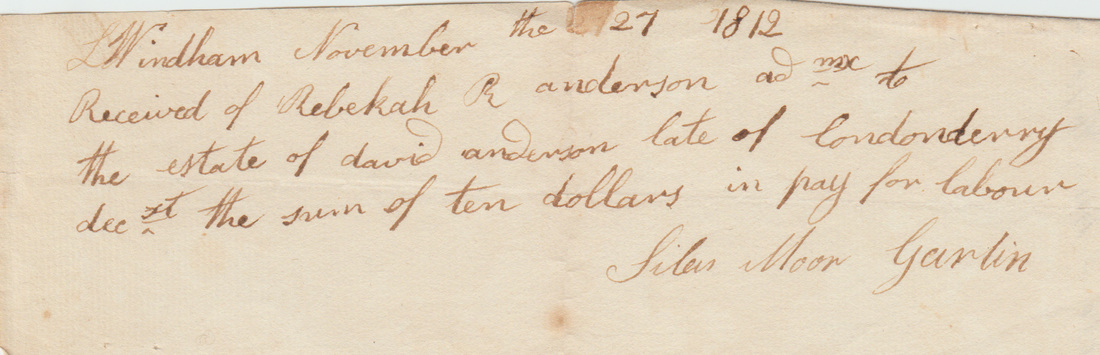
     On June 18, 1828, Silas Moor Garland was granted his request to officially change his name to Silas Moor. His wife, Hannah Moor Garland, Jeremiah Garland, and Martha Garland, also had their petition to change their surnames to Moor granted. There is no recorded reason as to why the Garland family of Windham had requested to change their surname to that of the family matriarch, Hannah. Hannah Moor, or Moore, was born on November 30, 1767 and died on October 10, 1832 at the age of 65. Not much is recorded about the details of Hannah's life. It is unknown when she married Silas Garland, or where he resided prior to the time he moved to Windham. It is possible that he had assumed the surname of his wife as part of his name after their marriage. He was a yeoman, working his farm to feed and support himself and his family; not unlike many of Windham's early settlers.
    When Garland purchased land from Jesse Crowell in 1814, he is recorded as being a resident of Windham. It is likely that he had been living on the property of the Moor's prior to that. The land he purchased was abutted by land owned by the Moor family. In 1816 Garland purchased land formerly owned by Samuel Cochran. He evidently was a modestly successful farmer because he expanded his property on several more occasions, just a couple years prior to his name change. His last purchase of land in Windham was registered in 1826, and there is no record of him ever selling the land, so it likely remained in the family. It is unknown if he remained in Windham following his name change.
    Together the Garlands had at least one child, Deacon Silas Moore. Deacon Moore was an elder of the Presbyterian Church, and was well respected in the community. Martha and Jeremiah Garland, were most likely also children of the Garlands. Morrison neglects to mention either of them, or even the elder Silas, in his book. The mystery surrounding the family's change of name will likely never be solved.
Picture
1812 note signed by Silas Moor Garlin (note the phonetic spelling of Garland)
3 Comments

THE APPLE CROP OF 1896

3/19/2016

0 Comments

 
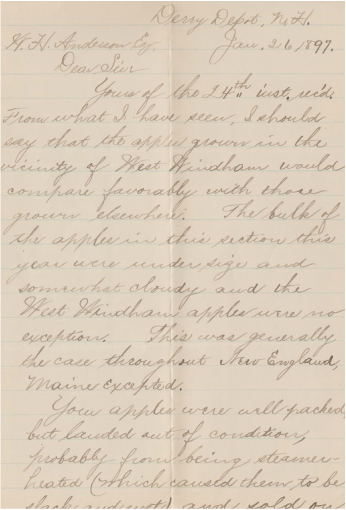
     At the turn of the twentieth century Windham was largely an agricultural community. The majority of the farms were small family-sized farms, many of which produced dairy products. Such farms operated with minimal hired help and rarely required the services of a hired manager. The farms were self sufficient; replacement animals were raised on the farms and fed the hay that was also grown on the farms. Aside from raising animals, some farmers grew and harvested apples. According to Rural Oasis the popular fruit would have been "packed in softwood barrels and loaded on the train for sale in a city or the apples were brought to one of the mills in town to be made into cider". In 1897 Charles McAllister received a letter from William H Anderson inquiring as to the apples produced on his West Windham property several months earlier. McAllister reported that "the apples grown in the vicinity of West Windham would compare favorably with those grown elsewhere".  However, the majority of "the apples in [West Windham] this year were under size and somewhat cloudy". As the same conditions were true for the bulk of the apple crop of 1896 in New England, Anderson could not have been too upset that his Windham apples were far from exceptional. Maine was the only state spared from the dismal apple crop. ​
Picture
Letter to William H Anderson regarding the apple crop in West Windham
     McAllister continues his letter by reporting to Anderson that although his apples were well packed, they were received in poor condition. He concluded that this issue may have resulted from the apples being "steamer heated", which caused them to become "slack and wet". To make matters even worse, the crop was sold on a market that was already replete with apples, forcing Anderson's representative to sell them at a low price. McAllister also used the letter as an opportunity to attempt to sell Anderson wooden apple barrels that he had too much of a stock of. While one train car of the barrels had initially sold at 25 cents a piece, the price per barrel rose and the initial customer did not need the entire second car of barrels. McAllister instructed the purchaser to sell all the unwanted barrels at 30 cents apiece. It seems that the buyer had quoted Anderson 25 cents apiece for the barrels and McAllister agreed to honor this price even though he would take a loss between the cost of the barrels and their delivery at the West Windham Station. Although apple season was several months away, Anderson likely could not have passed up such a deal.
0 Comments

JAMES HERBERT BARKER - WINDHAM'S PRINTER

3/5/2016

0 Comments

 
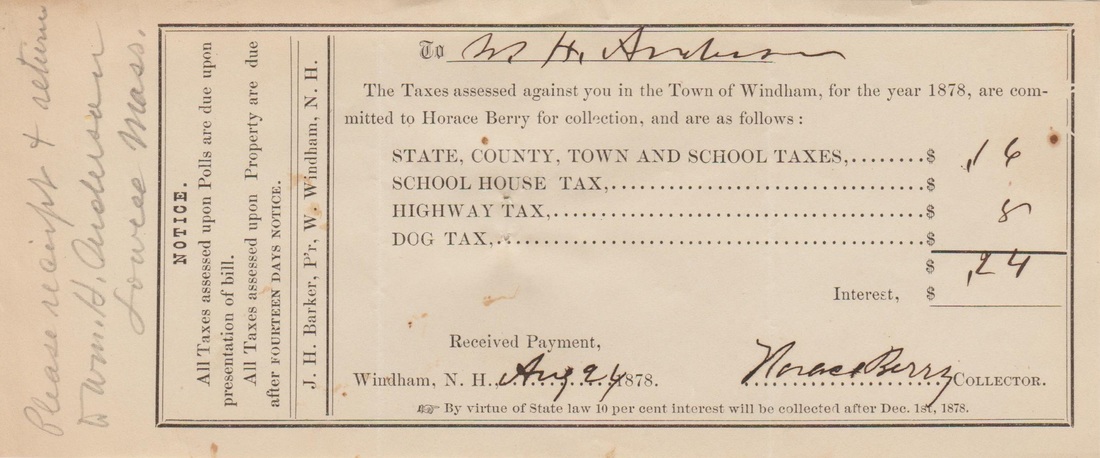
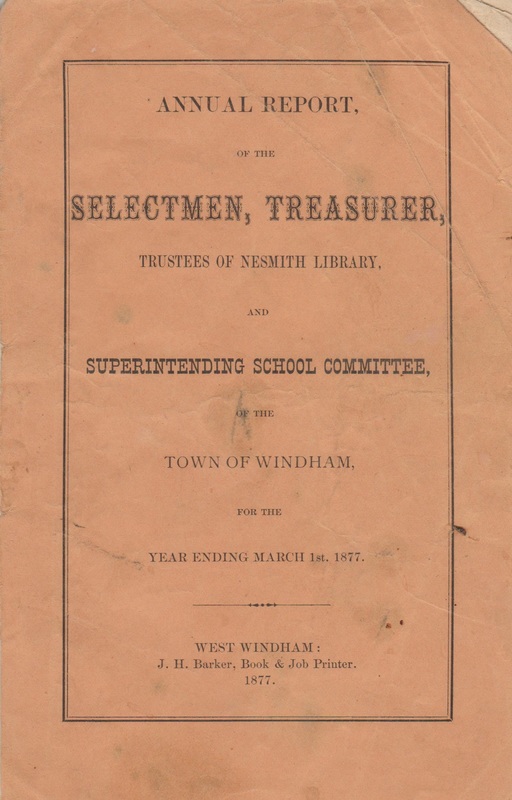
     James Herbert Barker was born on August 21, 1857. The first of James and Agnes Barker's two children, James spent his childhood on the family farm in West Windham. James, the father, had purchased the farm from Enoch Johnson a few years earlier and had constructed new buildings upon the property. In 1883, Leonard Morrison recorded that the elder James was currently living "in quietness, happily and prosperously". James, the son, likely opened his printing business in town in the latter years of the 1870s. As the only printer in Windham, the town awarded printing contracts to Barker; he printed the tax bills as well as town reports for several years. There are no records indicating Barker ever owned property in Windham, so it is likely he operated his business primarily from his family's property. ​
Picture
1878 town tax bill printed by J H Barker
    Prior to 1883 Barker left Windham for Nashua, where he opened a new printing business. Similar to his work in Windham, Barker was contracted to do printing for the city of Nashua, and even held the title of "City Printer", for a few years beginning in 1889. There is no record of Baker owning a home or business property in Nashua, so it is difficult to accurately ascertain how long he remained in Nashua. However, his printing operation was likely not in operation too long after 1895. ​
Picture
1877 town report printed by J H Barker
0 Comments

    Author

    Derek Saffie is an avid Windham historian who enjoys researching and sharing his collection with all those interested in the history of the New England town.
    ​

    Archives

    November 2019
    August 2019
    June 2019
    March 2019
    February 2019
    January 2019
    December 2018
    November 2018
    October 2018
    September 2018
    August 2018
    July 2018
    June 2018
    May 2018
    April 2018
    March 2018
    February 2018
    January 2018
    December 2017
    November 2017
    October 2017
    September 2017
    August 2017
    July 2017
    June 2017
    May 2017
    April 2017
    March 2017
    February 2017
    January 2017
    December 2016
    November 2016
    October 2016
    September 2016
    August 2016
    July 2016
    June 2016
    May 2016
    April 2016
    March 2016
    February 2016
    January 2016
    December 2015
    November 2015
    October 2015
    September 2015
    August 2015
    July 2015
    June 2015
    May 2015
    April 2015

    Categories

    All
    Anniversaries
    Drucker's Store
    Featured Stories
    Indian Rock
    Robert Dinsmoor
    W S Lamson Farm

© 2015-2019 Derek Saffie. All Rights Reserved.